Tuesday, July 14, 2015

Through the Andes

“Here they were shut off from that part of Peru which was under the sway of Pizarro and the conquistadors by mighty precipices, passes three miles high, granite canyons more than a mile in depth, glaciers and tropical jungles, as well as by dangerous rapids.”


-Hiram Bingham


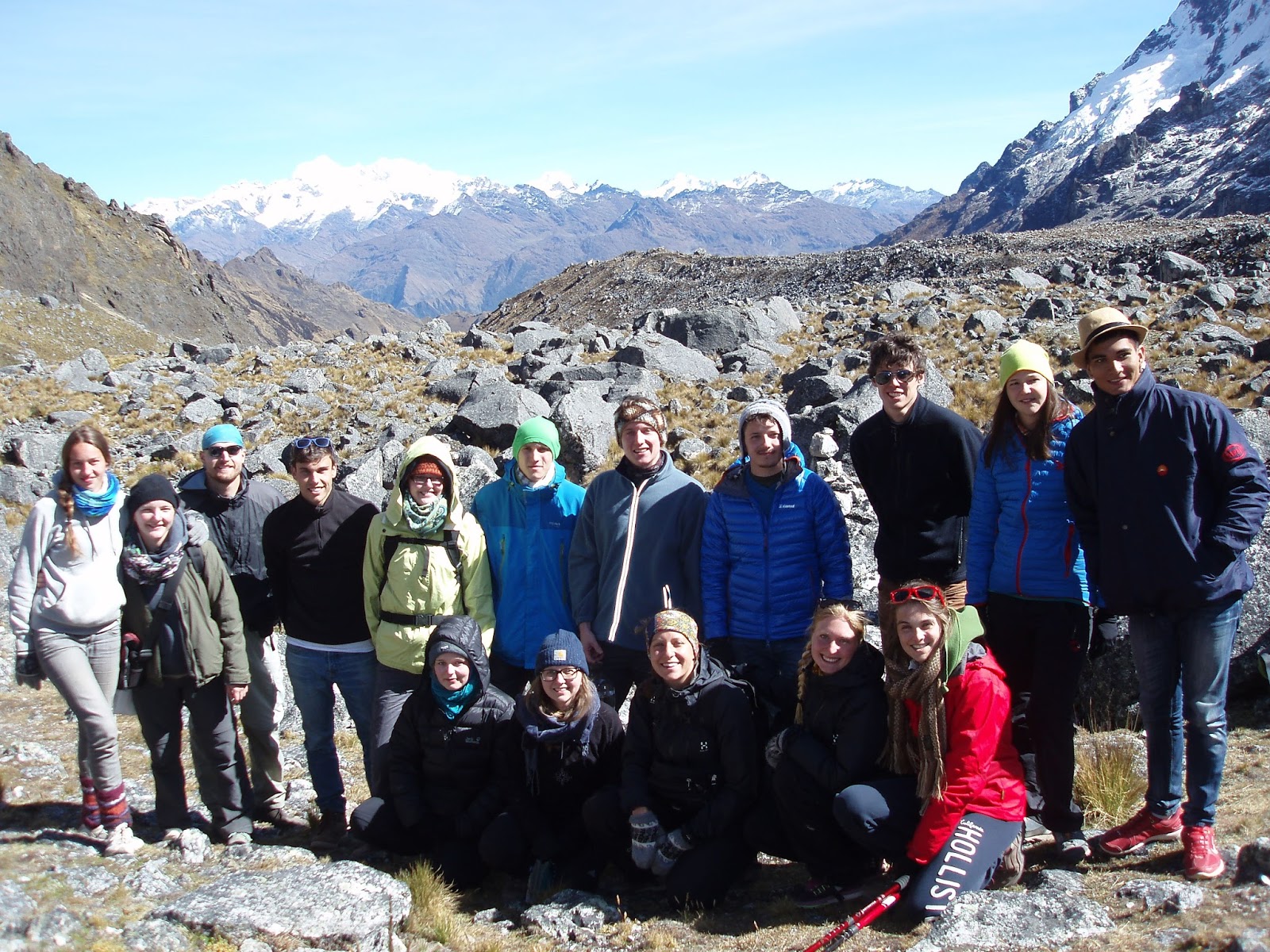
In Cusco I joined a guided 5 day/4 night group hike to Machu Picchu. In the group of 16 were 4 Austrians, 4 Belgians, 4 Germans, 2 Swedish, 1 Peruvian, and of course myself. We were to spend - in order - 3 nights sleeping in tents under the crystal clear southern cross, and one night in a hotel in Aguas Calientes – the town known as the gateway to Machu Picchu. Our fifth day would be spent exploring Machu Picchu herself. It was somewhat of a pilgrimage, I suppose.
The hike began in the high valleys outside of Mollepata among the local Quechua farmers and quickly gained elevation until reaching a level section of trail that met the specifications for
“peruvian flat” as our guide had lately come to introduce us. looking at Humantay Mountain in the distance, I was struck by how magnificent it was; how majestic, and how intimidating. The damned thing even gave me vertigo for a moment. It was not hard to understand how the Incas recognized this mountain as a God, then. We hiked 13 miles and set up camp directly underneath it. I suppose I've never been scared by a mountain before, but presently I wanted to sleep with a nightlight. Had I not been so tired, perhaps I would have asked for one. We were at 13,287ft. It was the highest altitude I had ever camped at.
The next morning I awoke well rested only to find out that two members of my party had come down with altitude sickness and were up all night throwing up. Poor bastards I thought. If only they could have enjoyed the early morning stars like I did; juxtaposed by Humantay Mountain and now Salkantay Mountain, instead of worrying if they would be able to continue on, or get a word out of their mouths without having it joined by the previous days lunch. The two of them benefited from a breakfast of pancakes spread with nutella and bananas, along with coca tea, and like two stubborn Europeans undaunted by circumstance, pushed forward. That I was happy for them should not be misunderstood, then, because the second day was as hellish as days comes in guided packages. Right away we got to hiking uphill. It was not steep, but gradual; which made it worse I think. At least when the trail is steep you gain elevation quickly. Indeed, gradual uphill is hard, and gradual uphill at elevation is the hardest. Fortunately we took many breaks and didn't have much distance to cover until reaching the highest elevation of our hike at 15,118ft. After we crossed over this pass we began our long descent into the Andean pre-jungle. On day two we covered 12.6 miles and a staggering 7,566 feet of elevation change. Needless to say, on day 3 I was sore and tired. Good thing we got to sleep in to 6:00am then, and even better that we got to relax in a natural hot springs outside of Santa Teresa the same day, after hiking only 8.1 miles and covering 2,914 feet of elevation change. We bought beer that third night at camp, and with every beer got a complimentary tequila shot. We took these blessings of the trail to the campfire and celebrated our third night in style. On our fourth day we hiked along the railroad tracks
underneath the imposing profile of Machu Picchu Mountain and Huayna Picchu Mountain. Once we had done this for about 7 miles we were finally at Aguas Calientes; and finally at a hotel with hot showers and clean beds. Most of us took advantage of the showers and explored the town a little until we had to go to sleep in order to get up at 4:00am to begin our early morning hike up to Machu Pichu.
So on our last day – Day 5 – we woke up well before sunrise and got to climbing the steep staircase steps outside the entry gate to Machu Picchu. Presently we were joined by many other groups who were there to do the last day with us. And so, about a hundred headlamps were on the ascent in total darkness. It looked like an early morning attempt at Mount Everest were it not for the jungle vegetation and the clean cut granite steps. Perhaps the best part about hiking in total darkness is the ease in which you can sneak off and pee without anyone noticing. I did this several times, and rejoined the conveyer belt when I was ready. When the sun finally rose we were at Machu Picchu and I was smiling because I did not have to pay the 1 soles to use the bathroom; Machu Picchu was nice too. It is a wonder of the world and has been described in detail here and there, and in a thousand books, so I will not burden anyone with a half ass, slip shod description of my own. All I will say is that I thought it deserved its place among the wonders of the world.
Our group hike ended with an hour and a half tour of the ruins, at the end of which we said our goodbyes and went our separate ways to explore the ruins further. I went to the Inca Bridge and the Sun Gate on the Inca trail and made sure to avoid anything that could pass for strenuous. Of course I relaxed in the ruins themselves and even tried to find places where I could hide and eat my lunch. It is a wonder all in itself that one can find a place of solitude among the currents of tourists passing through Machu Picchu. I still don't know how I got away with it. My lunch was terrible.

Saturday, July 11, 2015

Into the Andes

"Never let schooling interfere with your education"

- Mark Twain


Arriving in Lima, Peru my immediate thoughts were that it was very dirty and somewhat dangerous. Graffiti lined the walls of trash strewn streets and stray dogs were as common as crumbling buildings. Of course it was 1:30 in the morning, but I took the lack of human activity and the pothole ridden streets as signs to stay indoors at night. It was a wise thing too, as I heard some people come out later that night who were certainly not selling insurance. I believe they were salesman though. Good thing I was only staying the night, then. In the morning I went to the Cruz Del Sur bus terminal to high tail it out of Lima and make my way into the Andes mountains. As I was leaving on the second story of the luxury bus, comfortable as a clam in sand, I had a chance to see the entirety of the city by daylight and from a more relaxed position and among other foreigners; and consequently, my lasting thoughts of Lima, Peru were that it was very dirty and somewhat dangerous.
Following the welcome exile from Lima was a 23 hour bus trip; first through the Peruvian desert and then up into the winding roads of the Andes. Foolishly I assumed I would get sleep. I did not. Occasionally I took a nap of about twenty minutes before waking up in terror at the turns we were making, and the cliffs prone to landslides to our left making way for the 700 ft. drop-offs to our right. A railing would have been nice, but probably wouldn't have done a thing for anybody had our driver made even the slightest mistake. It was a good thing then that the stress only lasted for 15 hours until we reached Cusco.
In Cusco I allowed myself three days and three nights to acclimate to the elevation. Cusco, Peru is 11,200 ft. above sea level and it takes some time to get your breath when you first arrive, even if only walking around to visit the shops and restaurants. One should accept the fact that he will be light headed for the first day he is here, and maybe the second and third days too if he has sea level blood. It's a good place to acclimate in though; it is much friendlier and cleaner than Lima. In fact, it is even safe! One night I was startled by a local who caught me off-guard as I was walking back to my room. I thought for a second I was being robbed only to find out it was a kid trying to sell me a picture of a rainbow he had painted. He was nice enough, and once I had a chance to gather myself from the shock he put me through I told him where he could make improvements to his painting and finished walking back to my room.

Thus far Peru has been an exercise in traveling and acclimation. It has been an exercise in avoiding stray dogs and the smallest taxis known to man. It has even been an exercise in patience. In Europe, the service at a restaurant is poor, and they don't expect much of a tip for it. In America, the service at a restaurant is good, and they expect a big tip for it. In Peru, the service at a restaurant is horrifying, and they expect you to go into debt for it. There has been a terrible pattern of neglect here; neglect of good service and neglect of tourists to come forward and bear the bad news to them. As long as no one else will tell them, I will not either. Instead, I will thank them for their good manners outside the restaurants on the streets when soliciting anything at all. For these faithful sellers of trinkets and unnecessary courtesies it only takes one “no” and two “no thank you's” to send them on their way. This is good. This is wonderful. This is excellent even. In Asia the word “no” is valueless. You could say it a thousand times and on the one thousand and first time the solicitor will have as much energy as he did in the beginning. The rule there is to avoid eye contact and control your tunnel vision. While that rule is surely helpful in Peru, it is not necessary, and ultimately it is better to be polite and leave the encounter with a smile. I see nothing wrong with more smiles.

Thursday, May 28, 2015

Istanbul

“If the Earth were a single state, Istanbul would be its capital.”
- Napoleon Bonaparte

       
   So it was that we ended back in Istanbul for the final couple days of our tour of Turkey.  There is so much to see in Istanbul that it’s overwhelming if you’re the kind of person to get overwhelmed.  Our party began by seeing Topkapi Palace, followed by the Hagia Sophia, followed by the Cistern, followed by the Blue Mosque, followed by the Grand Bizarre, followed by yet another family dinner, followed by what could pass for sleep if questioned by a Navy Seal commanding officer, followed by the Pierre Loti cafĂ©, followed by the Spice Bizarre, followed by a visit to the top of the Sapphire building.  It was a furious pace for two days.  I was used to it by now. 
            Getting into Topkapi Palace proved to be a tricky thing; it teased us every step along the way.  First, with its unlimited supply of courtyards that we had to tramp through in order to get to the main grounds; second, with how everybody in Turkey and all of
Europe and Asia decided to see the palace the same day that we did.  Hacking through the people gathered in front of the main gate reminded me of doing the same thing when hiking through the jungles of Cambodia and Thailand; though this time there were no monkeys to dodge, only Europeans.  Once we got through, space opened up, but only briefly.  That is to say, we had about five minutes of room around us before we hit the lines that had formed outside of the museums.  Inside the museums were all sorts of odds and ends from Istanbul’s past glory days.  There were gifts from all manner of dignitaries around the world that had been given to various Sultans over the years; from diamonds the size of eagle eggs to turquoise bracelets and pearl necklaces.  The man that would wear such things in public must have been the highest breed of blowhard in the Middle East, and an unattractive blow hard at that.  The jewelry – though magnificent and worth more than 100 times what I could save in a lifetime – was as ugly as a sick elephant.  The tourists of course were gawking at all of the pieces.  They would comment here and there about how beautiful and delicate and charming and extravagant and precious and immaculate they were.  Tourists gawk at anything behind a display case.  I could put my bath towel behind one and claim it was used for washing a king, and they would gawk at it with their mouths dropped to the floor for hours.  Tourists remain as foolish as the day they were invented.

After Topkapi Palace, we visited the Hagia Sophia.  It was a church that was converted to a mosque that was converted to a museum.  It is the most interesting building in the world.  It is the only place I have been where Christian angels share the same roof as Muslim prophets; and where writings from the New Testament and the holy Quran are found together as easily as looking at the walls and ceilings.  It is said to have been the biggest cathedral in the world for hundreds of years, and I believe it, too.  The inside opens up and echoes every sound made a thousand times over; even more so after the mosque’s dome was added, I presume.  Greeks, Romans, Ottomans, Turks; I only wonder who will rent it out next; and whether they will keep it as a museum or change it again.  It took us an hour to see it and then we were out in the streets of Istanbul once more.
            By and by, we walked to a conspicuous place and were told to wait.  After some time, a line started to form and we realized, yet again, that we would be participants in its length.  I was told we were to see an ancient cistern.  I didn’t know what a cistern was, but it sounded uneventful, and if I had ever learned about it in grade school, it was evident now that I did not recall the lesson; chances are I had fallen asleep during it.  Apparently it is just a place that holds water for another place; usually a city.  Well then, no wonder I had fallen asleep.  We waited in the line for a half an hour and then saw what we had waited for.  It was underground, this cistern, and so we had to walk down some stairs to get there; and once we were there, we could not see much on account of the darkness.  The only lights came from the pillars which came straight up and out of the water.  There were boardwalks over the water zigzagging through the underground labyrinth.  We walked on these and took note of how intricate the cistern’s design was, and how much it was relied on during its peak importance.  Generations of Ottoman’s and Turk’s could flush their toilets as freely as they had need to.  They could drink and bathe as much as time would allow, too.  I was much impressed by these things.  The cistern turned out to be one of my favorite destinations on the whole tour of Istanbul.  Had I known what it was beforehand, perhaps I would have missed it altogether, but seeing it up close was a sure reward.

        
    The Blue Mosque was next for us.  Outside in front of the mosque we waited to enter by a particularly colorful arrangement of flowers.  It was one of the five times a day that was reserved for prayer; so, as they prayed, we got lost among the flowers.  That the Blue Mosque is a magnificent building to look at is no secret.  The minarets rise from the four corners like javelins, and the terraced domes roll over one another as if they were a part of the very earth.  It is true that the finest buildings in the world follow the maxim that less is more; and that being unique is better than being big – the Blue Mosque is no exception.  It is a sad thing, then, that the inside of the Blue Mosque is so ordinary and underwhelming.  Sure, walking on carpet in only socks is nice, and the detail of the hand painted blue wall tiles is quite something, but all in all it was an exercise in anti-climatic tourism.  We saw many people still praying and many who were still reading the Holy Quran, which lent to the ambience, but the sense of being lost in a foreign room went away as quickly as the line outside after the call to prayer.  I was left standing in the room not knowing what to do next, and the whole time wanting to go back outside to my flower patch and forget that I had ever entered.  Though I have been to Muslim countries before and seen many mosques, this was the first one I was allowed inside.  Perhaps had the outside architecture not been so beautiful the inside architecture might have done something for me.  I felt almost tricked, like when I found out that Santa Claus was not real, or that Eric Clapton was British.
            At length, we went around the rest of the city mostly shopping.  We shopped on Istiklal Street, at the Grand Bizarre, at the Spice Bizarre, and here and there wherever else interested us.  There is no shortage of shops in Istanbul.  Indeed, there are too many, even.  Every time you turn around there is another place where you can buy clothes, souvenirs, trinkets, odds and ends, and of course – Turkish delights.  Had I been alone, I would have walked by as if I hadn’t noticed their existence, but as I was not alone – and was with several women – we stopped frequently to engage in the mind drudging activity of shopping.  I elect to forget the details of those long hours spent inside the shops, and instead pretend as if I had gone fishing or taken a nap.  It is better this way.  The sooner I forget the sooner I can move on; this is the only way to get over tragedy, at least that’s what I’ve been told.
          Lastly, we went to the Sapphire Building.  We took an elevator to the top, looked around, saw some other buildings, some city streets, some moving cars, and left; thus ended our tour of Turkey.

Monday, May 4, 2015

The Old World

“There are two types of education… one should teach us how to make a living, and the other how to live.”

-         John Adams

Ephesus is said to have been one of the largest cities of the ancient Roman Empire.  Our guide told us this, in fact.  He told us it was the third largest among them.  Let’s assume, then, that it was the fifth or sixth largest among them.  No matter its former population – 250,000 according to our guide – its intricacies were fascinating, and its beauty was quite something.  We spent most of the morning walking through the ancient roads and looking at all the ancient sculptures and columns abound.  We saw the residential section full of houses, the library which could have been mistaken for a palace, the bath houses where aristocrats would take their baths together and socialize, the jail, the government buildings, the recreation halls, the market street, and of course the stadium.  It was not difficult to imagine what the city might have been like if it were around today.  The white marble has not faded much, but polished under the sun it would have been mesmerizingly bright and impressive.  A traveling diplomat would have surely been stunned upon arriving from the Aegean Sea and stepping off his ship at the port and making his way to the city center.  If he could keep his eyes off the hustle and bustle of the streets and look out to the mountain sides where the colors purple and yellow dominated every flower patch, he might even think he was in paradise.  Let’s forget how many slaves died building the city, and how many beggars must have been at its outskirts unable to get in.  If we do this, the city remains untouched by negativity.  After we had seen everything Ephesus had to offer, we had lunch and then left.
            The house of the Virgin Mary is located 5 miles from Ephesus on the top of a mountain; this is where we went next.  It cannot be verified, but it is assumed that the Virgin Mary was brought here by John the Apostle towards the end of her life.  The house itself was not discovered until the 1800’s following a vision by a Roman Catholic nun far away.  As we were on our way to the site, our guide managed to slip his voice into a crack in our conversation and widen it up so much that we were all presently paying attention to him as he began to throw out one questionable fact after the other; he was the kind of man who did this often, and so was a professional at it.  He saw himself as a stage performer while most of us saw him as a man blocking the windows.  There were several occasions where he would even keep us from taking a nap by mentioning the detailed steps to how pomegranate juice is squeezed.  As it was, we were on our way up the mountain and pretending to listen to him talk about the Virgin Mary, when suddenly the skies opened up and hail began to barrage our van with tremendous power and accuracy.  Not a single hailstone was wasted it seemed, for every last one of them made contact with our van and produced a deafening thunder of sound and vibration.  It got to the point where our guide had to stop his ramblings because we could not hear a word he was saying.  If there was a skeptic as to who lived in the house atop that mountain before, surely they were believers now.  And if ever mercy has been given, it was by her to us at this very moment.  We were all thankful.


            After Ephesus and Izmir, our group took a flight to Antalya.  It is one of the southern most cities in all of Western Turkey and known by many Europeans as a getaway vacation spot.  To most Americans it has never been heard of.  They may think of it as the Bahamas or Jamaica in the sense that is a place where a couple would have a wedding and perhaps even stay for the honeymoon.  The city is purely Mediterranean and couldn’t be mistaken as being anywhere else if seen on a picture or a post card; from the style of the buildings to their red tiled roofs, and from the brightly colored plants to the aqua colored water.  There are even snow capped peaks in the distance for good measure.  Our group took a boat tour under the sea side cliffs in order that we see all of this from the water.  It looked the same but with a cool sea breeze adding to it.  It would have looked like the coast of Italy or Greece if not for the mosques.  We took our time on the water and swam in the Mediterranean for some time before heading back to the docks.  I couldn’t help but think all the while that this was a city begging to be part of Europe.  It sure felt that it could be.
I should mention the food as well.  Now would be a good time for that considering how much we ate in Antalya, and also considering the beautiful places we did it in; but I ought to think it would take up too much space for now, and that I would not be able to do it justice, so it shall be saved for a later time.  It is back to Istanbul for us now.

Monday, April 27, 2015

Delightful Turkey

"Everything I missed so bitterly, my whole Turkish life ended forever: and the unique skyline was stamped inside my eyes in a way that can never be erased".

  -Pierre Loti


It had taken some time to get to Turkey, but as I was finally there I counted my luck among the luckiest.  After traveling so many times by myself and having the task of meeting others along the way, this time I had the good fortune of being part of a tour group from Boston.  And though this meant that I had to behave like a tourist, I did not mind it much.   If you look hard enough and scrape away the layers of obliviousness, some tourist’s can be tolerable. 
            We arrived in Istanbul after a nine hour flight, and immediately got to eating.  This would prove to be a major theme and a major occurrence on our trip. Never in my life have I eaten so many 4 course meals over the span of only 7 days.  Turkish people take as much pride in their food as any other nation I have visited; even China.  Both these countries would sacrifice a limb if only to defend the reputation and the honor of their food.  I ought to think Americans would do the same for hamburgers but know that, unfortunately, they would not.  As it was, we began by walking to the Bosphorus Straight and eating Kumpir by the water, followed by Turkish waffles and Turkish coffee; the latter of which I would indulge in frequently throughout the course of the trip.  We spent much of the night there – eating in Europe but looking at Asia - and only went to the hotel after we had satisfied our appetites as best as we could for the time being. 
            We did not stay in Istanbul the next day, but instead took a very early flight to Denizli where we were scheduled to see everything the city had to offer in a ferocious one day jaunt.  The city is mainly known for two things, and two things only: Pamukkale and their roosters.  It is said that the latter has the longest cock-a-doodle-do in the world, and after hearing some audio of them, I would have to agree.  We did not have the pleasure of seeing them first hand, but had to guess what they looked like based on all the monuments made in their honor.  This is the first and last time I think I shall ever see a monument of a rooster.  I hope it is anyway. 
            Next, we headed toward the famous travertine terraces of Pamukkale, and after a bath in a hot spring filled pool lined with ancient roman ruins, we were fresh on our way down the limestone hill.  There is no doubt that Pamukkale is a beautiful place, and that it has what is unique to only a handful of places on earth; but I simply cannot agree with the way Turkey chooses to disregard its fragility and allow tourists to molest it daily.  Everywhere one looks, he sees it being abused and taken advantage of.  In fact, the only thing stopping a tourist from falling off the edge and into the depths is a security guard with frail lungs blowing into a whistle that he most certainly fished out of a box of cereal that morning.  This same security guard has no objections to the tourist taking rocks from the natural wonder though, or stomping his feet all over un-solidified deposits of travertine, and keeps his plastic whistle holstered when he sees it.  I say let the tourist fall off the side and save your breath for the rocks; but that is only me.
            After Pamukkale, we went into Denizli to shop for textiles; of which Denizli is a huge exporter of.  I have never been much of a shopper, so Kelsey and I went for a walk outside among the mosques, minarets, and stray dogs of the city.  Nothing is more special than being in a foreign country and not knowing the language.  We talked to some book sellers and shop owners using hand signals mostly, listened to the call to prayer, and went back to meet the rest of the group.
We finished the day by eating dinner with a family of whom our guide knew from some previous employment or other.  The family was as gracious as hosts come, and as hospitable too.  They greeted us with the kindest words and then served us enough food to last a hungry man a month.  Finally, they let us go by adorning us with handmade towels and other thoughtful gifts.  My first impressions of Turkey are good ones, and if the rest of the country is anything like Istanbul and Denizli, then I anticipate only a wonderful time.  

Monday, August 12, 2013

Krakatoa (Indonesia)

Many a trip continues long after movement in time and space have ceased” - John Steinbeck


I carried further south into Indonesia. I should have reversed directions if it weren't for the momentum pressing me in that way - south of the equator and into a new hemisphere and a new country - but as it was, I followed the natural progression of any traveler with his nose pinned to a certain degree of the compass. I entered Jakarta to the realization that it was no place to linger for long, and readily made my way to Sumatra, and the small shore town of Kalianda. All the while I was traveling; whether it be by bus, or ferry, or taxi, or by foot, I was alone in my foreign skin with my foreign affairs and my foreign gait. Surely South Sumatra is off any tourist route, and I found it out by the countenance of surprise on every local as I passed them by en route to no where in particular. Now, Indonesia is a Muslim country and as it happened to be the month of Ramadan and all the locals were traveling back to their villages and towns to be with family, it also happened that I was tramping through it all as passively as if I was traveling through a super market. To suggest the locals were confused by my attendance on their holiest of weeks would be correct but in need of an upgrade. Perhaps flabbergasted. I don't suppose I pass as a Muslim on any day of the calender year. As I strolled meaningless down the streets in search of necessities like food and water, parents would alert their children of the stranger behind them with a tap on the shoulder and a point in his direction, and the children would be struck possessed judging by their long and deep gazes. And as for the older children, why, I have never known a simple “Hello” to bring a group of respectable looking adolescents into spontaneous smiling and euphoric laughter. But this was the way of the town, and I grew quite comfortable with my instant celebrity, even sometimes thinking I deserved it. Once they were over their shock, and I got to communicating, I understood them to be very happy and hospitable people, always willing to point a wandering jackass in the right direction, and most times with a smile to go with it. Yes, it was good enough town, I think.

Now, to the matter of why I was in Kalianda to begin with: Krakatoa Volcano. It has international fame as one of the most powerful, and one of the most deadly eruptions in recorded human history. It also has international fame as being one of the most seismically active and dangerous volcanoes today. When it last erupted in 1883, it killed multitudes of Javanese and Sumatrans who were unfortunate enough to be caught in its demon path of fire, mud, hurling projectile boulders, and steaming, boiling ash. The scene would have been taken from the hallways of Hell. The scores of villages and communities obliterated from existence not even being the whole story. See, the volcano was so powerful that it blew itself off the map; this is to be taken literally if this is to be taken accurately. Once all the ash settled over thousands of new graves, the location where Krakatoa once stood in the Straights of Sumatra was entirely ocean. Indeed, it erupted so violently as to remove itself from the geographic space which we call the surface of the earth. By and by, in 1927, Krakatoa's offspring appeared in the form of Anak Krakatoa; several lava flows creating a new island volcano where its father once ruled. I would visit this ill-tempered child of the sea, as I wished to witness its volatility on a personal level close up and first hand. Volatility is best taken this way. Perhaps I would even tell it some jokes to ease the tension, but not before I saw its thermal features, the jokes perhaps rendering it dormant.

Very well, as comedy would have it, I entered into a double outrigger canoe with bamboo trunks for floatation, a weed whacker motor for propellant, a cracked slab of wood for rudder, a paint job for laughter, and a crew for the same. I was assured the thing was sea worthy by the man who was capitalizing from the day; the man who profited either in the success or failure of the voyage; him being paid up front, and insisting on it from the beginning of negotiations. He would be on land counting the money I had given him while I would be out on the sea battling the high swells of the straights with his three crew members who could not speak English. One of these smoked the whole while, another bailed out water which continued coming into the hull, and the third - our captain, our leader, our navigator, the man in charge of our lives, well, he was busy in and out of sleep at the helm. Presumably, he had perfected this strategy of piloting over the years to enhance his alertness in case of trouble. See, he would be well rested and ready to tackle any emergency that arose. Why, the only emergency was that he was steering the damned thing! Anyway, this motley crew of rubes did their job, which apparently was to keep me alive, so I suppose all that was not lost was gained; except the 95 dollars.

The island of Anak Krakatoa smolders with sulfurous steam winding up through its various vents. As the wind shifts direction, one gets the full wall of odor at once, and then is relieved by another shift in wind direction. During these intervals of fresh breathable air, I hiked up the flank of the volcano over basalt so sharp that it cut through my boots with little effort. As I approached the last safe outlook before the cone became too dangerous to go further, I rested and took in the whole thing. Indeed, the volcano is alive with activity and seems almost to have a personality, and not a particularly nice one. In fact, I think if it could say anything, it has already said it in 1883, and will invariably say it again for all those within earshot, though it shall certainly be a short lesson! Very well, I had my time enjoying the Jurassic feel of the landscape with all its eccentricities and peculiarities and, by and by, I left the island and its blackness behind in favor of the white sand beaches of the mainland, where I laid content the rest of the day, thus ending this chapter of Krakatoa.  

Thursday, August 1, 2013

Here and There (Malaysia)

Now that we are poor, we are free” - Sitting Bull

Traveling on a budget is a bothersome thing. And, I suppose even in Southeast Asia a man should come to terms with the generality that spending money means he does not have that money any more. It is not green and it does not have a US president on it, so therefore it can be spent and spent with not a care or worry. In fact, some of the money is plastic and could readily pass for fake money, or money used in a child's game.  Certainly, at times, treating it as valueless has been great fun, but it does indeed have value, and value enough to plant me in Peninsular Malaysia for two weeks trying to recover my budgets dignity because of
errant spending in weeks previous. Well then, first I battened down the hatches in Kuala Lumpur and then decided the big city was no place to properly relax while budget recovering, so I journeyed back to the east coast destined for the small shore town of Cherating. As is requisite of any big city, I shall describe Kuala Lumpur as much as it needs describing and then leave it alone to go about its big city business. It is special for its relative diversity of Indian, Chinese, and Malays. Of course, among them are a large group of foreigners, as tends to be true of any large and cumbersome metropolis where financial matters are the main concern. I had the pleasure of staying in Chinatown with all the other irresponsible travelers. Very well, I explored the city as much as a curious wanderer with no funding cares to explore a city. I saw the Petronas Towers, some mosques of varying significance, some Hindu temples of varying irregularity, some restaurants worthy of revisit, some standard Asian shopping malls with unnecessary size and more floors than reason would suggest, and a cast of malevolent street characters – none of whom brought me any joy, but they brought me no usefulness. When a big city's quality of individualism wears off, one merely walks about tall buildings and filthy back streets with little purpose and no objective; similar to the stray cat and dog, and like the stray cat and dog, he fills only his basis needs. This was me on my last day in Kuala Lumpur so I immediately booked a bus ticket to the beach!


Cherating was my beach of choice. It is pushed up against the east coast of Peninsular Malaysia like the jelly fish that are pushed up against its shores. The beach itself is one long tidal flat where the water retreats two hundred yards daily according to the moons influence. It is famous for two things, and two things only: sea turtles and surfing. As the season only suggested investing in the former, it is where I put my money. See, the waves are quite pathetic during our summer months.
They meekly lapse over themselves, groveling as they make their way to your feet, and once they get to your feet, they are so exhausted that they lay there with no energy to speak of; it is a shameful spectacle. If only they would embarrass themselves at another beach, perhaps one without such a high reputation! At least the flats make for good lounging about, and the rather sedate tides make for a good bathing temperature, surely. It was the most objective-less week of my life thus far. Seemingly, life consisted of sleep walking to the beach 100 ft. from my door, falling onto the sand and then falling into sleep again. I should only compare it to college, I think, where the classroom was the beach.


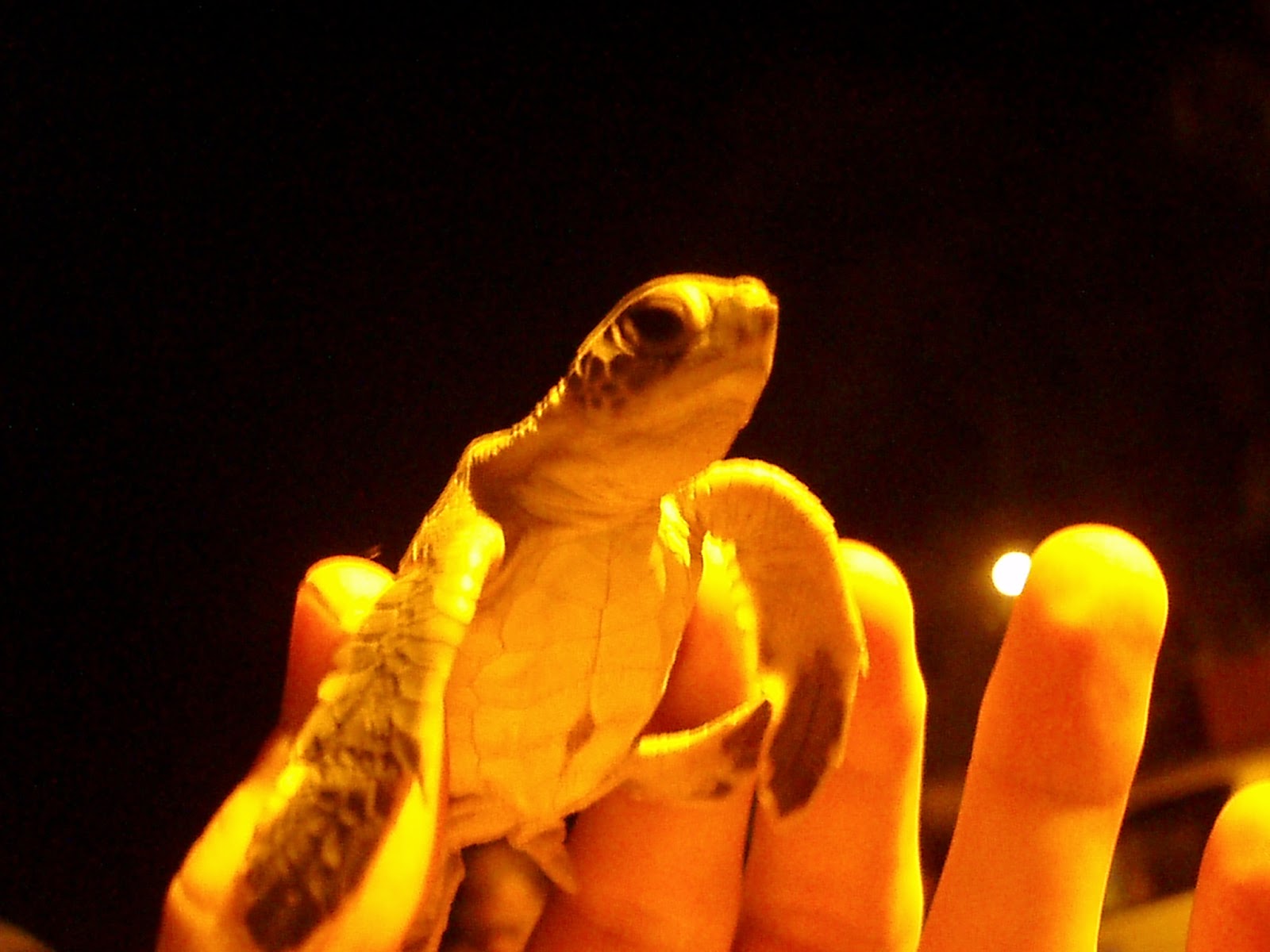
By and by, I found myself releasing sea turtles into the ocean. It is at night when the enormous 200 lbs. mother turtle comes ashore to lay her eggs and then retreat back into the warm ocean. My task was to watch her struggle digging a hole, then to watch her struggle crawling back to the water, and then to watch her struggle swimming against the current; I did a wonderful job. Afterward, my job was to set down a previously born sea turtle and let it struggle its own way into the ocean. It was a magnificent feeling to participate in such a rare and beautiful thing. We released 100 baby turtles in all. As they swam away under our dim headlamps, I couldn't help but to think how graceful they were once in the water, and how precious an event it was, and how meaningful my participation was, and how amazing nature can be, and how quiet the night, and how magical. Also, I couldn't help but to think that statistically, every single one of those baby sea turtles
would be devoured by malicious and starving fish not five minutes after we let them go. See, they cannot dive at such a young age, and as they float about, dumb and blind on the surface, they become easy prey for nearly every hungry thing in the ocean. If our headlamps were a bit more powerful, why, we could have seen it as it happened! The fish were fed, I suppose that is also magical.

Now, there happens to be some minor glitches in the whole thing: corruption and tourists. Of course, the witless tourist is led to believe he is helping conserve the species, and preserve their existence for all the future generations of this peaceful planet, but, indeed, he is a fool as his title suggests. While he is bathing in his humbleness and his good will toward Mother Earth, he is flashing the mother turtle like paparazzi at the red carpet, despite numerous warnings that it may just well blind its delicate eyes. He touches the shell and fins while she is on her quiet way back into the ocean, again, despite numerous warnings it could have negative impacts on the natural birthing processes of the mother. But, alas, he gets his picture and his story, so all is forgiven. And, the fee he pays goes in large part to the conservation of the species! In fact, more than half of what he pays goes directly into the sea turtle preservation project. What a hero he is! Why, if I believe that, I believe dogs and cats are old friends! If my fee goes in any part toward the honest preservation of sea turtles in Malaysia then Jupiter is a moon of Saturn, and the tuk-tuk ride is not a belligerent scam. God bless their souls, the people in charge of logistics. They are local volunteers who dedicate themselves to a cause that seems failing, and see no money for it. Every night they are out attempting to protect the sea turtles from the marauding villager who comes to steal the eggs and sell them, and the savage tourist who comes to steal common sense and never use it. May they be rewarded one day.


PS: all pictures taken here were done so WITHOUT flash.